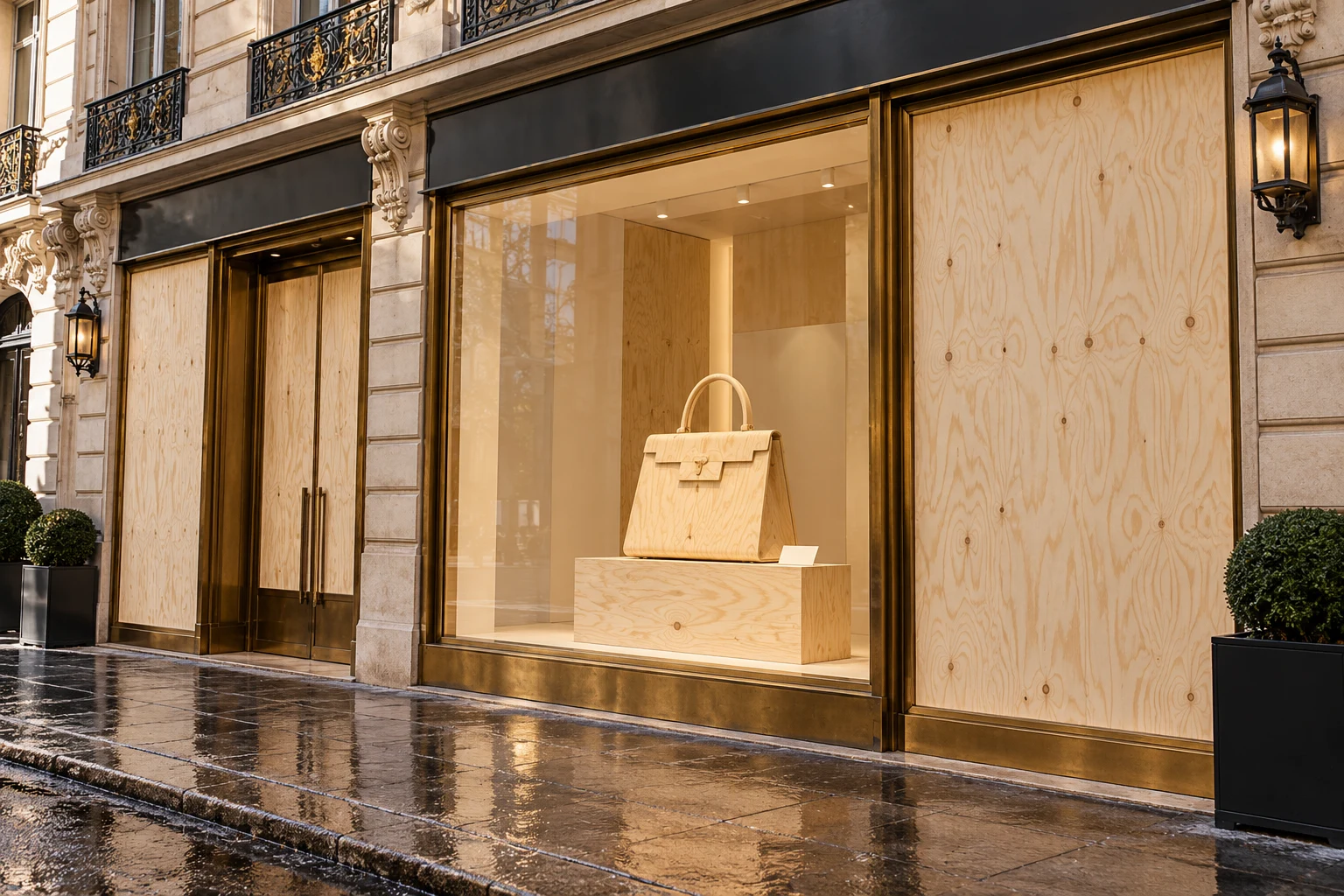
A fictional Paris fashion house has responded to boarded-up luxury shopfronts by announcing that the plywood is the collection. Clients who thought the boutique was closed have been informed that it is simply becoming more exclusive.
The real-world backdrop is straightforward: luxury retailers in France have boarded windows and increased security ahead of protests. At the entirely invented Maison Contreplaqué, this practical precaution has been reinterpreted as a profound investigation into who gets to look at a handbag.
“Glass was always rather democratic,” explained the house’s imaginary creative director, Lucien Delorme. “Anyone walking past could see the product. We wanted to restore some discretion.”
The debut piece, Le Panneau, is a rectangle of plywood priced at €4,200. It comes in Natural, which resembles plywood, and Heritage Natural, which resembles plywood that has been discussed by a historian. Both are available in a smaller size at a larger price.
A press release describes the visible grain as “the material’s unfiltered personal journey”. The nails are not nails but points of tension between permanence and desire. Removing one invalidates the warranty and, according to the house, misunderstands the work.
An accompanying handbag is made from the same material as the window covering. It cannot be opened, a feature sales staff describe as financial wellness. The first customer to ask whether rain would damage it was gently redirected towards a more accessible brand.
Purchasing a panel requires an appointment, two references and evidence of a longstanding relationship with timber. A British visitor who mentioned having shelves was told that ownership alone did not demonstrate commitment.
Fashion editors have praised the collection’s radical refusal to be useful. One particularly moved critic observed that the board both concealed the merchandise and became the merchandise. This was precisely the kind of sentence that justified a flight to Paris.
Meanwhile, the carpenter who fitted the original protection returned to collect his tools. He was stopped at the entrance because his overalls suggested he might intend to do something. After explaining his role, he was invited to a private viewing of his invoice.
He pointed out that the boards cost considerably less at the builders’ merchant. A publicist smiled with the exhausted kindness reserved for people who confuse what something costs with what it is worth.
The house has since announced a waiting list for offcuts. These will be sold as fragments of access.